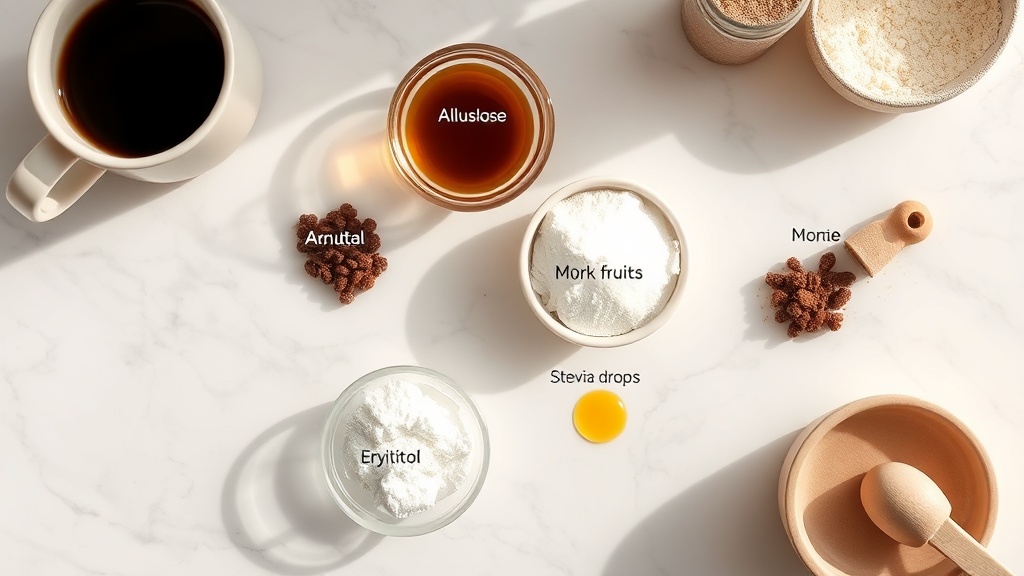
The Low-Carb Sweetener Guide I Actually Stand Behind (From Someone Who's Tried Them All)

The Low-Carb Sweetener Guide I Actually Stand Behind (From Someone Who's Tried Them All)
I've had monk fruit in my coffee. I've baked with allulose. I've suffered through a stevia aftertaste that lingered until Tuesday. And I've watched clients get completely paralyzed in the baking aisle because there are now forty-seven sugar alternatives and every keto influencer has a different favorite.
So here's my honest breakdown — as a registered dietitian who also happens to bake a lot — of the sweeteners that are actually worth your money, the ones that work in specific situations, and the ones I'd skip entirely.
First: Why Sugar Alternatives Matter for Carb-Conscious Eating
Let me be clear about something. I'm not anti-sugar. Table sugar is not poison. But if you're actively managing your carb intake — whether that's for blood sugar control, PCOS, weight management, or just feeling better — sugar is one of the easiest places to cut back without sacrificing the foods you love.
The right sweetener swap can save you 20-40g of carbs per recipe. That's meaningful when you're aiming for 50-100g per day.
But not all sugar alternatives are created equal. Some spike your blood sugar anyway. Some taste like chemicals. Some bake beautifully. Some turn your brownies into hockey pucks.
My Tier List (Yes, I'm Ranking Them)
Tier 1: The Ones I Actually Keep in My Kitchen
Allulose
This is my number one. Allulose is a rare sugar that occurs naturally in figs, raisins, and maple syrup. It tastes about 70% as sweet as sugar, has virtually zero glycemic impact, and — this is the big deal — it behaves like sugar when you cook with it. It browns. It caramelizes. It keeps baked goods moist. It doesn't crystallize weirdly.
I use it in my coffee, in baking, in sauces, in everything. It's about 0.2-0.4g of carbs per teaspoon that your body actually absorbs (the FDA doesn't even require it on the sugar line of nutrition labels anymore).
The catch: It can cause GI distress in large amounts — bloating, gas, sometimes loose stools. Start with small quantities and build up. Most people tolerate 30-40g per day without issues. Also, it's more expensive than other options.
Erythritol
My second favorite, especially for cold applications. Erythritol is a sugar alcohol that's about 70% as sweet as sugar with zero calories and zero glycemic impact. Unlike other sugar alcohols (more on those below), erythritol is absorbed in the small intestine and excreted unchanged — meaning it doesn't ferment in your gut the way maltitol or sorbitol do.
It has a slight cooling sensation that some people notice, especially in frostings or candy. I don't mind it, but it's real. In baking, it can crystallize if there's not enough moisture, so I usually blend it with allulose or use it in recipes with plenty of fat.
The catch: You may have seen headlines about an erythritol-heart-disease study from 2023. Here's my take: that study found a correlation between high blood erythritol levels and cardiovascular events in people who already had heart disease risk factors. Your body naturally produces erythritol from glucose, so elevated blood levels might be a marker of metabolic issues rather than a cause. The research is preliminary, and I'm still comfortable using it in moderate amounts. But I keep an eye on the literature.
Tier 2: Great in Specific Situations
Monk Fruit Extract
Monk fruit is intensely sweet — about 150-200x sweeter than sugar — so it's usually blended with erythritol or allulose to make it measurable. Pure monk fruit extract is great for sweetening drinks, yogurt, oatmeal, or anything where you just need sweetness without bulk.
I like it in my iced tea and in salad dressings. It has no aftertaste for most people (unlike stevia), and no known blood sugar impact. The flavor is clean and round.
The catch: It can't replace sugar 1:1 in baking because it doesn't provide the bulk, moisture, or browning that sugar does. Those "monk fruit baking blends" are really erythritol blends with a tiny bit of monk fruit. Which is fine — just read the ingredient list so you know what you're actually using.
Stevia (Liquid Drops)
I know stevia gets a bad reputation for that bitter, metallic aftertaste. And honestly? In powdered form, I kind of agree. But high-quality liquid stevia drops — especially ones that use reb M or reb D steviol glycosides instead of the cheaper reb A — have come a long way. The aftertaste is minimal.
I use liquid stevia in lemonade, smoothies, and homemade electrolyte drinks. A few drops go a long way, and it's genuinely zero-calorie, zero-carb, zero-glycemic.
The catch: Baking with stevia alone is rough. It doesn't provide volume, it doesn't brown, and if you overshoot even slightly, the bitterness will ruin your recipe. Keep it for beverages and cold prep.
Tier 3: Proceed With Caution
Xylitol
Xylitol is a sugar alcohol with about 40% fewer calories than sugar and a lower glycemic index (around 7 vs. sugar's 65). It tastes remarkably close to sugar — probably the closest of any alternative — and it's genuinely good for dental health. Dentists love it.
But here's why it's in tier 3: It's extremely toxic to dogs. Even small amounts can cause hypoglycemia, liver failure, and death in dogs. If you have a dog — and I do — this one makes me nervous. One spilled container, one dropped cookie, and you've got an emergency vet visit. I keep it out of my kitchen for this reason alone.
It also still has about 2.4 calories per gram and does raise blood sugar somewhat, so it's not truly "free" from a carb-conscious perspective.
Maltitol
You'll find maltitol in a LOT of "sugar-free" commercial products — candy, chocolate, protein bars. It's cheap for manufacturers, and it has a glycemic index of about 35. That's lower than sugar, but it's not low. For comparison, a Snickers bar has a GI of about 51.
I'm not a fan. Maltitol still raises blood sugar meaningfully, and it's notorious for GI distress — the "sugar-free gummy bear" horror stories you've read online are almost always about maltitol. If a "low-carb" bar lists maltitol as a sweetener, I personally subtract only half of those sugar alcohol grams, not all of them, when estimating net carbs.
Tier 4: Skip It
Sucralose (Splenda packets)
Sucralose itself is 600x sweeter than sugar and passes through your body mostly unabsorbed. The issue is that Splenda packets contain maltodextrin and dextrose as bulking agents — which are basically glucose. Each packet has about 0.9g of carbs. Three packets in your coffee and you've added almost 3g of carbs from something you thought was "zero calorie."
Liquid sucralose (no bulking agents) is fine if you like the taste. But those yellow packets are deceptive for carb-counters.
Also, recent research suggests that sucralose may affect insulin sensitivity and gut bacteria in ways we don't fully understand yet. I'm not sounding alarm bells, but when I have better-studied alternatives, I don't reach for this one.
Aspartame (Equal, NutraSweet)
Aspartame is probably the most studied artificial sweetener in history, and the research consensus is that it's safe at normal consumption levels. I'm not going to fear-monger about it.
But from a practical standpoint, it breaks down at high temperatures (can't bake with it), has a distinct aftertaste that many people dislike, and offers no functional advantage over monk fruit or stevia for low-carb purposes. It's just not the best tool for the job anymore.
My Actual Kitchen Setup
Here's what's in my pantry right now:
- Allulose (granulated) — for baking and cooking. My workhorse.
- Erythritol/monk fruit blend — for when I want something sweeter without extra volume. I like the Lakanto brand.
- Liquid stevia drops (reb M) — for drinks only.
That's it. Three sweeteners cover every situation I encounter. You don't need twelve products.
The Questions I Get Most
"Do sugar alternatives still trigger cravings?"
Some people report that sweet tastes — even without calories — keep their sweet tooth activated and make it harder to reduce overall sugar intake. This is real for some people, and if that's you, I'd rather you use a small amount of real sugar or honey than fight a losing battle with sweetener-fueled cravings. The research on this is mixed, and individual variation is huge.
"Are they safe long-term?"
Allulose and erythritol have solid safety profiles in studies up to several years. Stevia has been consumed in South America and Japan for decades. None of them are new — they're just newly popular in the U.S. market. I feel comfortable with my current choices, and I'll update if the evidence changes.
"Can I mix sweeteners?"
Yes, and I actually recommend it. Blending two sweeteners (like allulose + a small amount of monk fruit) often produces a more sugar-like sweetness than either one alone. They cover each other's weak spots — allulose brings bulk and browning, monk fruit brings intensity.
Bottom Line
You don't need to become a sweetener scientist to eat fewer carbs. Pick one or two from my top two tiers, experiment a little, and don't let perfect be the enemy of a really good chocolate mug cake. The best sweetener is the one that helps you enjoy your food while staying on track with your goals — and for most people, that's allulose or an erythritol-monk fruit blend.
If you try one new sweetener this month, make it allulose. Your baking will thank you.